
Rebuilding Confidence: Why Canada Must Fix Its Capital Formation Gap
Why Access to Capital—Not Ambition—is the Real Innovation Problem


By John Ruffolo, Founder & Managing Partner Maverix Private Equity and Co-founder, Council of Canadian Innovators
There is a quiet anxiety spreading through Canada’s innovation community.
You hear it in university corridors. You hear it at startup events. You hear it from founders who haven’t even incorporated yet.
The anxiety isn’t about ambition. Canadian founders are as ambitious as their peers in Silicon Valley, Austin, or New York. Our universities produce extraordinary engineers, scientists, and builders. Our founders punch far above their weight globally.
The anxiety is about something more structural.
Capital.
Canada is one of the wealthiest countries in the world. Yet we struggle to finance our own innovators.
That disconnect lies at the heart of the problem.
Too many young Canadian entrepreneurs believe that if they want to build a globally meaningful company, they eventually need to leave Canada – often for the United States.
The recent controversy involving Y Combinator illustrated the issue perfectly. For a brief moment, Canadian founders applying to the accelerator were effectively told they would need to incorporate as Delaware C-Corps rather than Canadian companies. The policy was later walked back. But the signal was loud. I refer you to this article I wrote for the backstory https://www.linkedin.com/pulse/what-all-fuss-really-john-ruffolo-utkuc.
It reinforced a narrative many founders already believe: serious capital lives south of the border.
Whether that perception is entirely true is beside the point. Perception shapes behaviour. And behaviour shapes where companies build.
From a public policy perspective, Canada faces three structural challenges in supporting innovation:
Access to Talent
Access to Customers and Markets
Access to Capital
The federal government has begun addressing the first two and is working on the third. Immigration policy is shifting toward smarter, targeted talent attraction. Government procurement reforms - particularly around defense & dual use technologies – are beginning to allow Canadian startups to sell to the public sector.
Those are welcome steps and we look forward to more. In the digital economy, success is also determined by the rules of the game—standards bodies, data governance frameworks, intellectual property protection, and international trade agreements. Canadian startups will need the active engagement of government to ensure those rules evolve in ways that allow our companies to compete and scale globally.
But if you ask founders what keeps them up at night, the answer is almost always the same.
Access to capital.
And capital formation is not a single cheque. It is an ecosystem.
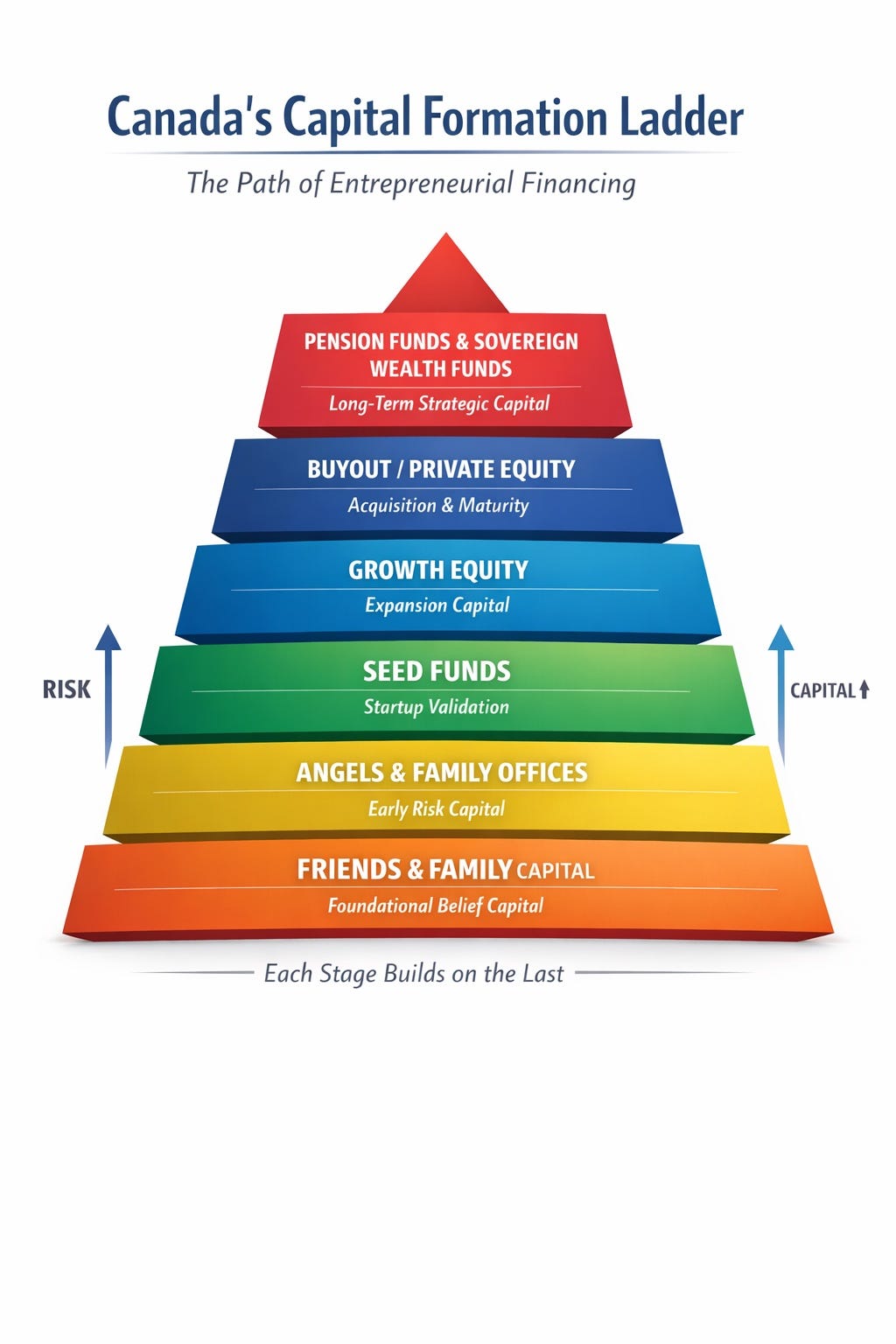
Canada’s Capital Formation Ladder
Canada is surprisingly inefficient at capital formation. Aging demographics, large government deficits, high taxes, and unproductive capital trapped in housing all make it harder to generate the pools of capital needed to finance productive assets.
Except for Alberta, which at least attempted to build a sovereign capital pool through the Heritage Fund, Canada has rarely created large domestic capital reserves dedicated to economic development.
Our pension funds are globally respected and extraordinarily successful, yet they largely bypass Canadian entrepreneurs in favour of foreign assets. Venture and private equity funds struggle to raise domestically and rely heavily on foreign investors to achieve scale. And our banks, while stable and conservative, rarely provide the kind of long-term risk capital required to build globally competitive technology companies.
So Canadian innovators look abroad for funding.
That might sound benign until you remember that every country is rediscovering the importance of economic sovereignty. The United States is prioritizing “Buy American.” Europe is weaponizing regulation. China has long been playing its own state-backed capital game.
Access to foreign capital will not always be as easy as it once was.
Every successful innovation ecosystem is built on a ladder of capital. Each rung supports the next. At the bottom are the highest-risk investors. At the top are the largest pools of capital.
When one rung weakens, the entire system becomes unstable.
Canada’s challenge is not that the ladder does not exist.
It’s that several rungs are too thin.
Friends and Family: The Kitchen Table Economy
Every startup ecosystem begins with the least institutional form of capital imaginable. Friends. Family. Credit cards. Second mortgages.
The earliest investors in a company are not underwriting spreadsheets. They are underwriting belief and personal relationships.
Canada’s challenge at this stage is structural. We simply have fewer historical liquidity events and less generational entrepreneurial wealth than the United States. Combine that with higher individual income tax rates and that means the pool of individuals capable of writing early cheques is smaller.
Canada’s tax system also sends mixed signals about what kinds of investment we value.
Capital gains on principal residences are fully exempt, which has helped fuel enormous investment in housing. Yet entrepreneurial capital—arguably the most productive form of risk capital in an economy—receives far less favourable treatment.
That imbalance shapes behaviour.
Canada has built one of the most powerful tax incentives in the world for housing—and one of the weakest for innovation.
Canada levies the 5th highest marginal rate of individual income tax at 54% out of the 38 countries in the OECD. When you adjust it for the tax brackets at which the highest marginal rate is levied, Canada is ranked the 2nd highest marginal rate of individual income tax in the world. A decade ago, the highest rate was 45%. With respect to capital gains taxes, Canada’s highest marginal rate of 26% is higher than the OECD average of 20% and ranks 4th highest (before adjusting it for tax brackets).
Public policy could help rebalance this.
Possible ideas include capital gains deferral when proceeds are reinvested into Canadian startups, expanding the lifetime capital gains exemption for founders and early investors (refer to discussion below), allowing greater use of TFSAs for investments in Canadian private companies, and enhancing the SRED tax credit and federal and provincial grant programs for Canadian controlled private companies.
In August 2025, draft legislation proposes a revised tax-deferral regime for individuals who sell shares in an eligible small business corporation (ESBC) who reinvest the proceeds into another eligible small business. To qualify, the replacement share can be acquired in the calendar year of the disposition or the following calendar year, the corporation must be a Canadian-controlled private corporation (CCPC) with a size threshold, and the shares must generally be those of an active business corporation, with the business carried on primarily in Canada.
The goal is simple: encourage Canadians who succeed once to invest in the next generation of entrepreneurs.
Angels and Family Offices: The First Professional Risk Capital
Angels – whether high net worth individuals or family offices – provide the first real professional risk capital in an innovation ecosystem. They play a disproportionate role in turning early ideas into venture-scale companies.
But this is where Canada’s policy disadvantages start to become more visible.
In the United States, investors benefit from the Qualified Small Business Stock (QSBS) regime, which allows investors who hold qualifying startup shares for five years to exclude significant capital gains from taxation.
Matt Cohen’s recent memo for Build Canada laid out the issue clearly. https://www.buildcanada.com/memos/reward-the-risk-takers . This topic was likely at the centre of the recent Y Combinator controversy in which I summarized in the link above.
Matt argues Canada’s tax system still treats entrepreneurial success as something to tax rather than something to cultivate.
Reforms could include expanding the Lifetime Capital Gains Exemption toward a QSBS-style framework, introducing flow-through share structures for innovation, and creating a national angel tax credit program.
Matt proposes modernizing Canada’s capital gains framework to better support entrepreneurs and early-stage investors by expanding eligibility, increasing incentives, and updating structural rules. He recommends broadening the program so it applies to all industries of national interest—including healthcare, clean energy, and technology—and eliminating the 5% minimum ownership requirement so founders, employees, and smaller investors can benefit. To make Canada competitive with peer jurisdictions, he suggests raising the capital gains exclusion cap to the greater of $15 million in gains or 10× the adjusted cost basis per taxpayer. He also proposes structural reforms, so the benefit applies per business rather than once per lifetime, encouraging repeat entrepreneurship.
Canada already uses flow-through shares to finance mineral exploration. The same concept could be applied to innovation—effectively treating intellectual exploration the way we treat mineral exploration. For a detailed understanding of the flow through shares idea, refer to https://canflowthrough.com/
To better understand what a national angel tax credit program might look like, refer to the report from the National Angel Capital Organization (NACO) https://digital.builtbyangels.com/view/327527710/
Seed Funds and Venture Capital: Institutionalizing Risk
Once startups graduate beyond angel capital, they enter the world of institutional venture capital.
Canada has built credible venture infrastructure over the past two decades. Programs like the Venture Capital Catalyst Initiative (VCCI) have helped anchor funds and attract institutional capital.
The 2025 Federal Budget reaffirmed that commitment with a $1 billion renewal of the VCCI program. Here is the link for more information https://ised-isde.canada.ca/site/ised/en/programs-and-initiatives/venture-capital-catalyst-initiative.
These initiatives have helped strengthen Canada’s early-stage ecosystem. Other initiatives that have been discussed include providing tax incentives for domestic investor participation through angel tax credits in funds, and a corporate venture capital tax credit to incentivize corporations in Canada to invest in venture capital funds.
But venture capital is a scale business. A single large U.S. venture fund can deploy more capital than several Canadian funds combined.
Which means Canadian founders eventually hear a familiar suggestion:
“Have you considered relocating the company?”
That is not a capital problem alone.
It is a scale problem.
Growth Equity: The Missing Middle
The gap becomes most obvious when companies begin to scale.
Canada has built a relatively strong early-stage venture ecosystem, but domestic capital thins dramatically at the growth stage.
In a report from the Canadian Venture Capital Association (CVCA), Canadian investors dominate early rounds—accounting for roughly 80% of financings under $5 million—but their participation drops sharply as companies raise larger rounds. In financings above $50 million, Canadian-only participation falls significantly while foreign investors increasingly lead the rounds. Among 35 of the largest Canadian growth rounds between 2021 and 2024, under 30% were led by Canadian investors.
Leadership matters.
Lead investors influence governance, board composition, and exit pathways. When those investors are foreign, strategic decisions often migrate abroad as well.
The 2025 federal budget proposed a $750 million growth capital initiative to address this gap. Strengthening domestic lead-investor capacity at scale is essential if Canada wants to retain ownership, governance influence, and economic value from the companies it helps create. https://budget.canada.ca/2025/report-rapport/chap1-en.html
Buyout Funds: Stewardship Capital
Private equity is often misunderstood in Canada.
Done properly, buyout capital provides long-term stewardship, operational expertise, and strategic discipline.
The healthiest innovation ecosystems are circular. Entrepreneurs build companies, exit, and then reinvest their wealth as angels and venture investors.
When that cycle works well, capital formation compounds.
Pension Funds: Canada’s Capital Giants
Canada’s pension funds are among the most sophisticated investors in the world. Collectively they manage well over $2 trillion dollars.
They invest globally and generate excellent returns.
But a legitimate policy question remains: should they invest more domestically?
Historically Canada experimented with rules that limited how much pension capital could be invested abroad. Few investors want to see those rules return.
Forced allocations rarely produce good outcomes.
But it is worth remembering something: pension funds are not purely private institutions. They exist because of very favourable public policy treatment under the Income Tax Act, allowing their investment income to compound tax efficiently. For example, in 2006, Canada eliminated income trusts because they were hollowing out the corporate tax base. Ironically, pension funds often receive similar tax advantages in Canada.
That raises a reasonable question.
If pension funds benefit from extraordinary policy support, should they also consider the long-term prosperity of the domestic economy they ultimately depend on?
This does not mean forcing allocations.
But it does mean encouraging thoughtful domestic investment.
Consider Quebec’s CDPQ. It has demonstrated that it is possible to invest globally, generate excellent returns, and still support the development of strategic industries at home.
Those objectives are not mutually exclusive.
In fact, they can reinforce each other.
Invest in Canada. Canada prospers. Pension assets grow. Everyone wins.
Former Bank of Canada Governor Stephen Poloz recently examined how Canada might encourage pension funds to invest more domestically. His approach was pragmatic: remove structural barriers and create larger, investable opportunities that match the scale pensions require.
Among the ideas explored were eliminating outdated rules like the “30 percent rule,” which limits how much voting control pension funds can take in Canadian companies, and creating larger, investable opportunities that match the scale pensions require. The work also pointed toward expanding public-private co-investment vehicles in areas such as infrastructure, energy grids, and data infrastructure, while using programs like the Venture Capital Catalyst Initiative and new growth capital funds to crowd in institutional capital.
If Canada structures opportunities properly, pension funds will invest here—not because they are told to, but because the opportunities are attractive.
Sovereign Capital: Canada’s Missing Pot of Gold
In a recent essay titled Canada’s Missing Pot of Gold https://johnruffolo.substack.com/p/canadas-missing-pot-of-gold I argued that Canada should consider establishing a national sovereign investment vehicle focused on strategic sectors.
Around the world, governments increasingly recognize that industries such as artificial intelligence, semiconductors, advanced manufacturing, and space infrastructure are not just commercial sectors. They are pillars of national competitiveness.
Countries like Norway and Singapore have built sovereign investment vehicles that deploy capital strategically across these industries.
Canada, by contrast, has enormous pools of capital but no coherent national investment strategy around them.
Much of the capital required to scale Canadian technology companies ultimately comes from foreign investors whose fiduciary duty lies elsewhere. When that happens, the intellectual property, headquarters, and economic spillovers that accompany those companies often migrate abroad as well.
The argument is not for government control of industry.
It is for creating a disciplined sovereign investment vehicle capable of anchoring large investments in strategic sectors while crowding in private capital.
In a world where technology, capital, and geopolitics increasingly intersect, Canada cannot rely solely on market drift.
It needs a strategy.
Canada’s Entrepreneurs Are Ready
The greatest risk facing Canada’s innovation ecosystem is not structural.
It is psychological.
If founders believe the capital ladder ends halfway up, they will simply move to where it continues.
But if Canada strengthens every rung—from angels to pensions—we create a self-reinforcing ecosystem.
One where founders do not need to leave to scale.
One where Canadian companies remain Canadian companies.
And one where innovation compounds domestically.
Canadian entrepreneurs are not asking for protection.
They are asking for a fighting chance.
Canada does not lack talent.
It does not lack ambition.
It does not lack ideas.
What it needs is a capital architecture that matches the ambition of the people building its future.
Because if we build the ladder properly, something remarkable happens.
Founders stop leaving.
And the world starts coming here to build.
By John Ruffolo, Founder & Managing Partner Maverix Private Equity and Co-founder, Council of Canadian Innovators
Fantastic breakdown of the positive and the gaps we have here in Canada. Especially agree with your thoughts on sovereign funds. Huge opportunity if we can quickly get organized.
Amen!